
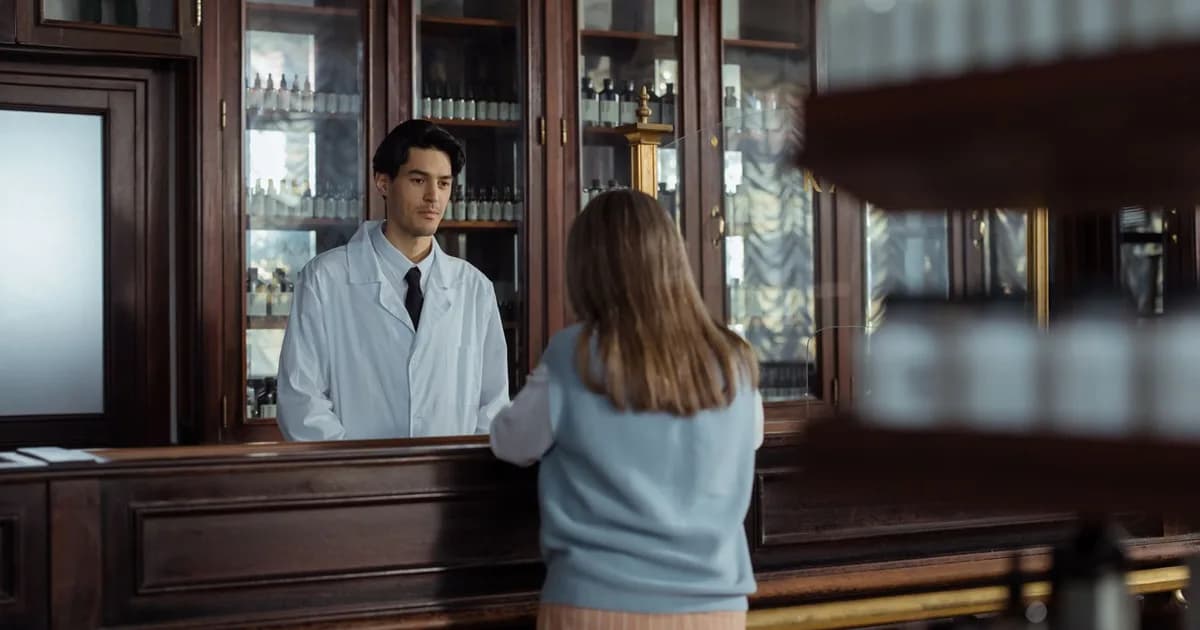
The phone rings during a dispensing
In France, the order of 28 November 2016 on good dispensing practice (arrêté du 28 novembre 2016 relatif aux bonnes pratiques de dispensation) defines dispensing as the pharmaceutical act that combines the supply of medicines with the pharmaceutical analysis of the medical prescription, if there is one, the possible preparation of the doses to be administered and the provision of the information and advice needed for the proper use of medicines. The same text recalls that dispensing takes place in conditions of confidentiality that allow a conversation to be held out of earshot of third parties.
Answering at the counter therefore means interrupting a pharmaceutical act and, sometimes, talking about another patient in front of the one who is waiting. The question is not how to answer faster, but which calls can be handled somewhere other than at the counter.
What phone reception can handle
Many calls are practical information: opening hours, opening days, access, parking, services offered by the pharmacy, the general terms of an order or a pick-up. These answers require no pharmaceutical skill, provided they are written by the team and kept up to date.
Reception can also take a message for a callback: name, number, subject in a few words and when the person can be reached. The subject must stay general (“question about a treatment”, “order waiting”): the details are then discussed with the pharmacist.
What must never leave the counter
Pharmaceutical advice is part of dispensing: dosage, interactions, side effects, choosing an over-the-counter medicine, what to do about a symptom. This advice is for the pharmacist, and for the pharmacy technicians (préparateurs en pharmacie) who assist them under their responsibility and effective supervision (article L4241-1 of the French Public Health Code): it cannot be delegated to a phone reception, human or automated.
Health data calls for the same caution. Article L1110-4 of the Public Health Code, cited by the Ordre des pharmaciens (the French National Order of Pharmacists), covers all information concerning the person that has come to the knowledge of the professional and of any member of staff, and applies to all professionals working in the health system. The pharmacists’ code of ethics, recast by decree no. 2026-156 of 3 March 2026, also provides in article R4235-5 that the pharmacist ensures that the people under their authority are informed of their obligations regarding professional secrecy and sees that they comply with them. In practical terms, reception collects only the minimum needed for the callback, and confirms nothing about a patient to a third party who calls.
On-call pharmacies: where the information is organised
According to the 3237.fr website, run by the pharmaceutical unions in charge of organising on-call duty, on-call and emergency services are set by the representative organisations of the profession in each département, under article L5125-22 of the Public Health Code. To find an on-call pharmacy, the site cites the notice in pharmacy windows, the town hall, the police station or the SAMU (the French emergency medical service), and, in many départements, the paid 3237 audiotel number, charged at 35 centimes per minute, as well as an online search on 3237.fr. Sante.fr, the public health information service, gives the same rate: €0.35 including VAT per minute.
The same site specifies that, in some areas, an on-call pharmacy can be opened only on prior request to the police station or the gendarmerie, or by calling 15 (the French emergency medical number), and that a prescription and the carte Vitale (the French health insurance card) are asked for. For your reception, the right answer outside opening hours is to refer callers to these up-to-date sources rather than to name an on-call pharmacy from memory.
Writing down the line before delegating
Before handing the phone to anyone, write two lists: the subjects reception handles on its own, with the exact answer to give, and the subjects that trigger a message for the pharmacist. Add a simple hand-over sentence, along the lines of “that’s a question for the pharmacist, I’ll pass your request on to them”, to be used as soon as a caller starts describing symptoms or a treatment.
If the situation described seems urgent, reception does not have to assess it: it directs the caller to the emergency services. Review these lists regularly with the team, particularly after a question that left reception in difficulty.
A reception that does not give advice
Alyas, the AI voice agent, answers only from the information you give it, such as your opening hours or the steps for finding the on-call pharmacy, and when a question falls outside that scope, it says so and offers to pass the request on. It announces at the start of the call that it is an AI and that the call is recorded; recordings, transcripts and summaries are hosted in the European Union. A caller may nonetheless mention their health: have the framework applicable to this data checked with your DPO or your legal adviser before going live. A caller who asks to speak to someone is transferred to your transfer number. Advice stays at the counter. A free 10-day trial, with no credit card required, lets you check the agent’s behaviour against your own instructions.
Frequently asked questions
What should you say to a caller who starts describing their symptoms?
That the question is for the pharmacist and that a message will be passed on to them for a callback. Reception does not assess symptoms; if the situation seems urgent, it directs the caller to the emergency services.
Does 3237 work in every département?
The 3237.fr site states that this audiotel number is available in many départements, not all of them. The other sources it cites are the notice in pharmacy windows, the town hall, the police station and the SAMU.
Is a team member who is not a pharmacist bound by secrecy?
Yes. Article L1110-4 of the Public Health Code, cited by the Ordre des pharmaciens, covers information that has come to the knowledge of any member of staff, and article R4235-5 of the same code, as worded by the decree of 3 March 2026, requires the pharmacist to ensure that the people under their authority know their secrecy obligations and comply with them.
Sources
- Légifrance - Order of 28 November 2016 on good dispensing practice (annex) (in French)
- Ordre national des pharmaciens - Professional secrecy (in French)
- 3237.fr (RésoGardes) - About on-call duty (in French)
- 3237.fr - Nearest on-call pharmacy (in French)
- Légifrance - Decree no. 2026-156 of 3 March 2026 amending the pharmacists’ code of ethics (in French)
- Légifrance - Article L4241-1 of the Public Health Code (pharmacy technicians) (in French)
- Santé.fr - Out-of-hours care: on-call pharmacies (in French)