
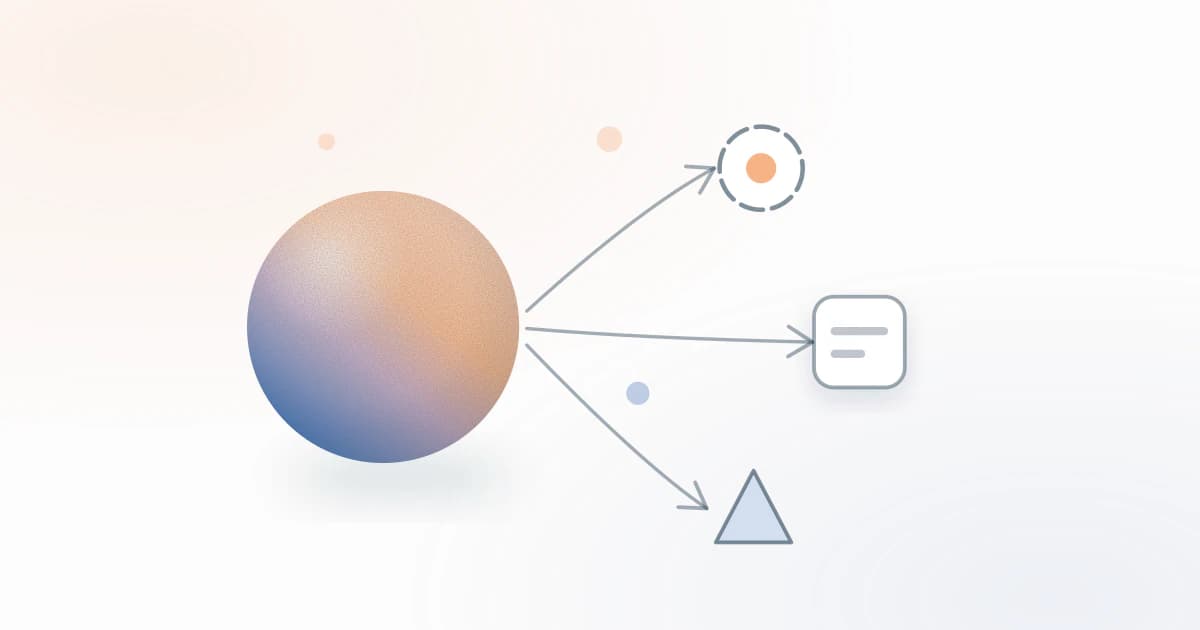
Definition: perceive, decide, act
Google Cloud defines AI agents as software systems that use AI to pursue goals and complete tasks on behalf of users. They show reasoning, planning and memory, and have a level of autonomy to make decisions. Google presents reasoning and acting as their main characteristics, alongside others such as observing (gathering information about the environment or situation) and planning; acting can mean sending messages, updating data or triggering other processes.
Anthropic, which builds the Claude models, offers a useful distinction in a technical article published in December 2024. “Workflows” are systems where a language model and tools are orchestrated through paths predefined in code. Agents, by contrast, are systems where the model dynamically directs its own process and tool use, keeping control over how it accomplishes the task; Anthropic stresses that at each step they need to rely on concrete feedback from their environment (tool results, for example) to assess their progress.
In both cases, the basic building block is an augmented language model: it can retrieve information, call tools and keep a memory. Without tools or access to the company’s data, a language model converses; with them, it can act. It is this ability to act, more than apparent intelligence, that justifies the word “agent”.
Agent, assistant, chatbot: where the line falls
Google Cloud ranks these three notions by their degree of autonomy. A bot follows predefined rules and reacts to triggers or commands; it suits simple tasks and conversations. An assistant responds to requests, provides information and can recommend actions, but the user makes the decision. An agent is the most autonomous: it can carry out multi-step actions and make decisions independently to reach a goal.
In practice, the line is blurred. France’s Commission for the Enrichment of the French Language defines the “dialogueur” (the officially recommended French term for “chatbot”) as software specialised in natural-language dialogue with a human, able in particular to answer questions or trigger the execution of tasks. A chatbot that books an appointment into a calendar is already performing a task; an “agent” sold as such sometimes follows an entirely scripted path.
For a business, then, the right question is not the label but the scope: what information does the system consult, what actions can it trigger, which of them are reversible, and who is alerted when it stops? A tightly framed system, close to a workflow, is often more reliable for a repetitive task than an agent left to its own devices.
Concrete business examples
At the front desk, an agent answers customers’ questions using the company’s information, by phone or in writing. It perceives the request, decides whether it can answer, and acts: it takes down contact details, offers a slot in a connected calendar or passes the request on to a person. The value lies less in the conversation than in what comes out of it, namely a complete, usable request.
In the back office, an agent can sort incoming emails by topic and prepare a draft reply for someone to approve, extract the useful information from a purchase order to pre-fill a record, or match an incoming request to an existing customer file to avoid duplicates. In each of these cases, the final action can still be checked before it commits the company.
For monitoring or analysis, an agent can gather documents, extract the relevant passages and produce a summary. Here too, the result is a starting point: it cites its sources, and a person checks it before using it to make a decision.
The limits you need to know
Anthropic points out that agents’ autonomy comes at a cost: higher costs and a risk of errors compounding from one step to the next. Its advice is to start with the simplest solution and only add complexity if it genuinely improves the outcome, after extensive testing in a sandboxed environment and with appropriate guardrails.
Google Cloud, for its part, lists several situations where AI agents struggle: tasks requiring deep empathy or handling complex social dynamics, situations with high ethical stakes such as medical diagnosis or legal judgements, and unpredictable physical environments. To this you can add a very practical limit: an agent only knows what it has been given. Information that is out of date or missing from its sources will produce a wrong answer or a dead end.
Finally, an agent is not accountable for what it does: the company that deploys it is. Every automated action must therefore be traceable and, where possible, reversible.
Human oversight: what to plan for
Oversight starts with scope. Separate read actions (checking a calendar, looking up information) from actions that commit you (booking, sending, changing data), and keep the latter for well-defined cases. For anything with significant consequences for a person, the CNIL, France’s data protection authority, points out that a conversation with a chatbot, without human intervention, cannot on its own lead to a decision such as refusing credit; it can form part of a process that includes meaningful human intervention.
Next, provide a way out to a human at every stage: on explicit request, when the agent cannot find the answer, or when the subject is sensitive. Keep a readable history of what the agent saw, decided and did, and regularly review a sample of conversations to correct its instructions and fill in missing information.
This is the approach Alyas takes for front-desk handling: the agent answers by phone and in writing using the information you provide, can book an appointment in Google Calendar or Cal.com, and hands over when needed, by transferring the call to your number on the phone, or in chat by flagging the conversation and alerting your team by email.
Frequently asked questions
What is the difference between an AI agent and traditional automation?
Traditional automation follows a sequence fixed in advance: if this condition, then this action. An AI agent relies on a language model to interpret a freely worded request and choose for itself which steps and tools to use. It copes better with varied requests, but needs more testing and more guardrails.
Can an AI agent work without supervision?
It can carry out tasks without intervention at every step, but not without a framework. You need to define the permitted actions, plan for a person to take over when the agent does not know or when the stakes are high, and regularly review what it has done. In France, the CNIL points out that a decision with significant consequences for a person cannot result solely from a conversation with a chatbot.
Do you need to know how to code to use an AI agent in a business?
No, not for everyday uses such as front-desk handling or answering frequently asked questions: off-the-shelf solutions are configured with your information and your instructions. Development becomes necessary when the agent has to act within specific internal tools that have no existing connector.
Sources
- Google Cloud — What is an AI agent? (in French; updated 2 April 2026)
- Anthropic — Building effective agents (19 December 2024)
- FranceTerme — “Dialogueur” (French official gazette, Journal officiel, 9 December 2018) (in French)
- CNIL — Chatbots: the CNIL’s advice on respecting people’s rights (in French)