
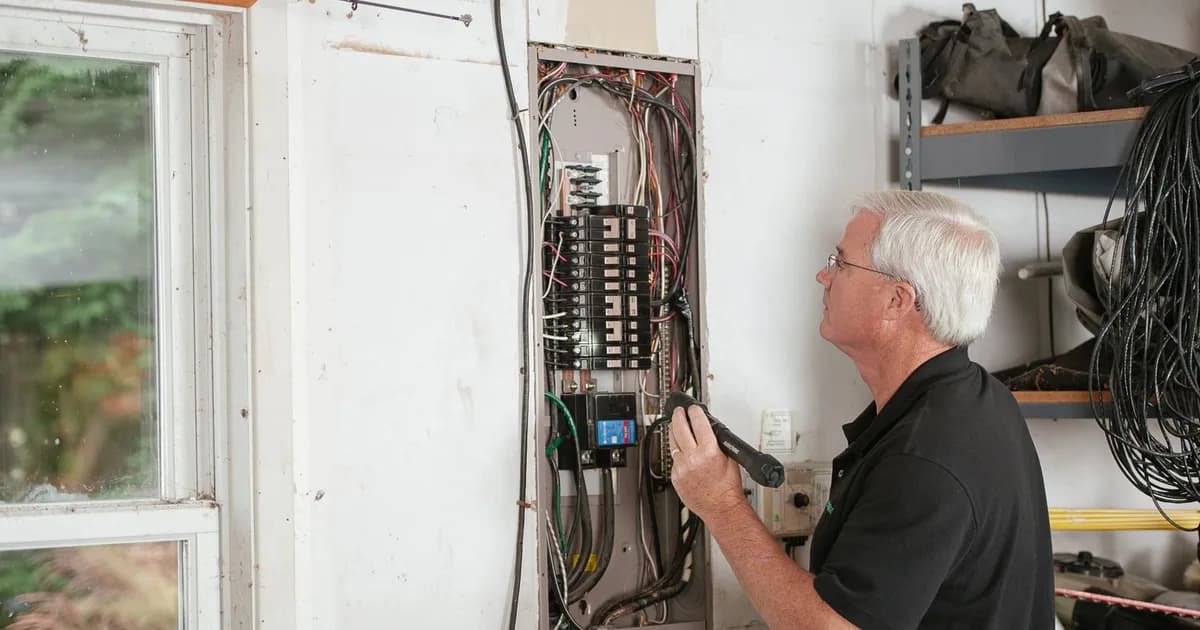
First question: is the fault on the network or at the customer’s premises?
Enedis, the operator of the electricity distribution network across most of France, advises checking whether the neighbours have also lost power. If they have, it may be a general or local outage, and an electrician is not the one to deal with it: Enedis’s breakdown service is responsible. It can be reached 24 hours a day, 7 days a week, on 09 726 750 followed by the two digits of the département (the French administrative area).
This simple question avoids a pointless call-out and immediately directs the customer to the right party. One nuance is worth your reception knowing: according to the énergie-info website of France’s national energy ombudsman (Médiateur national de l’énergie), local distribution companies (entreprises locales de distribution, ELD) operate across about 5% of the territory, electricity and gas combined, in areas not served by Enedis or GRDF (the French gas distribution network operator); they manage the distribution network there. If you work in one of those areas, state the local network operator and its breakdown number in your instructions.
Situations where nobody touches anything
Enedis lists four situations in which nothing should be touched: a power cable on the ground, a broken cabinet, a smell of burning or a black mark, a meter or circuit breaker with no cover. In those cases, Enedis asks people to contact its emergency breakdown service directly. Your reception can repeat this instruction word for word: it is short, it comes from the network operator and it asks for no handling at all.
If the caller reports that someone has received an electric shock, the priority changes. The INRS, the French national research and safety institute for occupational health and safety, stresses that you must act very quickly: cut the power without touching the victim’s body, then call or have someone call the emergency services, that is the Samu (15, the French emergency medical service), the fire brigade (18) or the emergency number 112. The instruction to give is then to call the emergency services immediately, before any other step involving your business.
What the reception must not do
Enedis publishes checks that the occupant can carry out themselves: lamps, sockets, appliances, circuit breaker and fuses. They are addressed to the customer, who carries them out under their own responsibility. Your reception, by contrast, can see neither the panel nor the installation: it must not guide a manipulation step by step, advise resetting a circuit breaker that keeps tripping, have a panel opened or reassure with an “it’s probably nothing”.
Nor must it announce a probable cause, a response time or a price that the technician has not validated. A hypothesis voiced over the phone quickly becomes, in the customer’s mind, a diagnosis. The only advice to give is the kind that requires no skill: touch nothing if there is any sign of danger, call the network breakdown service if the neighbourhood is affected, call the emergency services if someone is hurt.
The information that lets the technician decide
Once safety is dealt with, the call serves to prepare the technician’s decision. The useful items are the full address and access conditions, the type of premises (home, shop, business premises), what no longer works (the whole home or only part of it), since when, whether the neighbours have power, and what the person observes without touching anything: smell, noise, heat, black marks.
Add whatever changes the order of visits: a commercial freezer that has stopped, a person who depends on an electrical device, premises that cannot open. Finish with the callback number and the caller’s availability. With this information, the technician calls back already knowing whether to set out, call back to clarify or redirect the caller to the network operator.
A short script, written by the person who does the work
The reception script works best in three stages: first safety (signs of danger, injured person), then the sorting between network and installation (do the neighbours have power?), and finally the collection of information. It is the electrician who must write or validate it, not the person who picks up, because it is the electrician who takes responsibility for the instructions given.
Review the script after every call that went badly: a missing question, an instruction that was misunderstood, a customer sent to you when the outage came from the network. That is how it adjusts to your customers and your area.
Where a voice agent fits in this sorting
Alyas, the AI voice agent, can handle this first level when you are on a job or at night: it announces at the start of the call that it is an AI and that the call is recorded, answers from the information and instructions you have given it, such as the network operator’s breakdown number, and says when it does not know, offering to pass the request on. You find the transcript and summary of each call in your workspace, and a caller who asks is transferred to your transfer number. It replaces neither the technician’s diagnosis nor the emergency numbers. A free 10-day trial, with no credit card required, lets you test your script on real calls.
Frequently asked questions
Who should you call when the whole neighbourhood has lost power?
The distribution network operator, not an electrician. In the areas served by Enedis, its breakdown service answers 24 hours a day on 09 726 750 followed by the two digits of the département. In areas managed by a local distribution company, that is the company to contact.
What should you say to a customer who smells burning near the panel or the meter?
To touch nothing. Enedis cites a smell of burning and black marks among the situations in which nothing should be handled and its emergency breakdown service should be contacted. If someone is hurt or a fire has started, the priority is to call the emergency services.
Can the person who picks up advise resetting the circuit breaker?
It is better to avoid it. They cannot see the installation and cannot judge the risk. Their role is to gather what the customer observes without touching anything, then pass it to the technician, who decides what happens next.
Sources
- Enedis - Which number to call in case of a power cut? (in French)
- Enedis - How to identify an electrical fault? (in French)
- Enedis - I have no electricity: the right steps to take (in French)
- INRS - Electrical accidents (in French)
- énergie-info (Médiateur national de l’énergie) - What is a local distribution company? (in French)